Monday - Friday 07:30 - 17:30, Saturday 07:30 - 16:00
Engineered Floor Sanding in Upper Holloway
Back to Portfolio
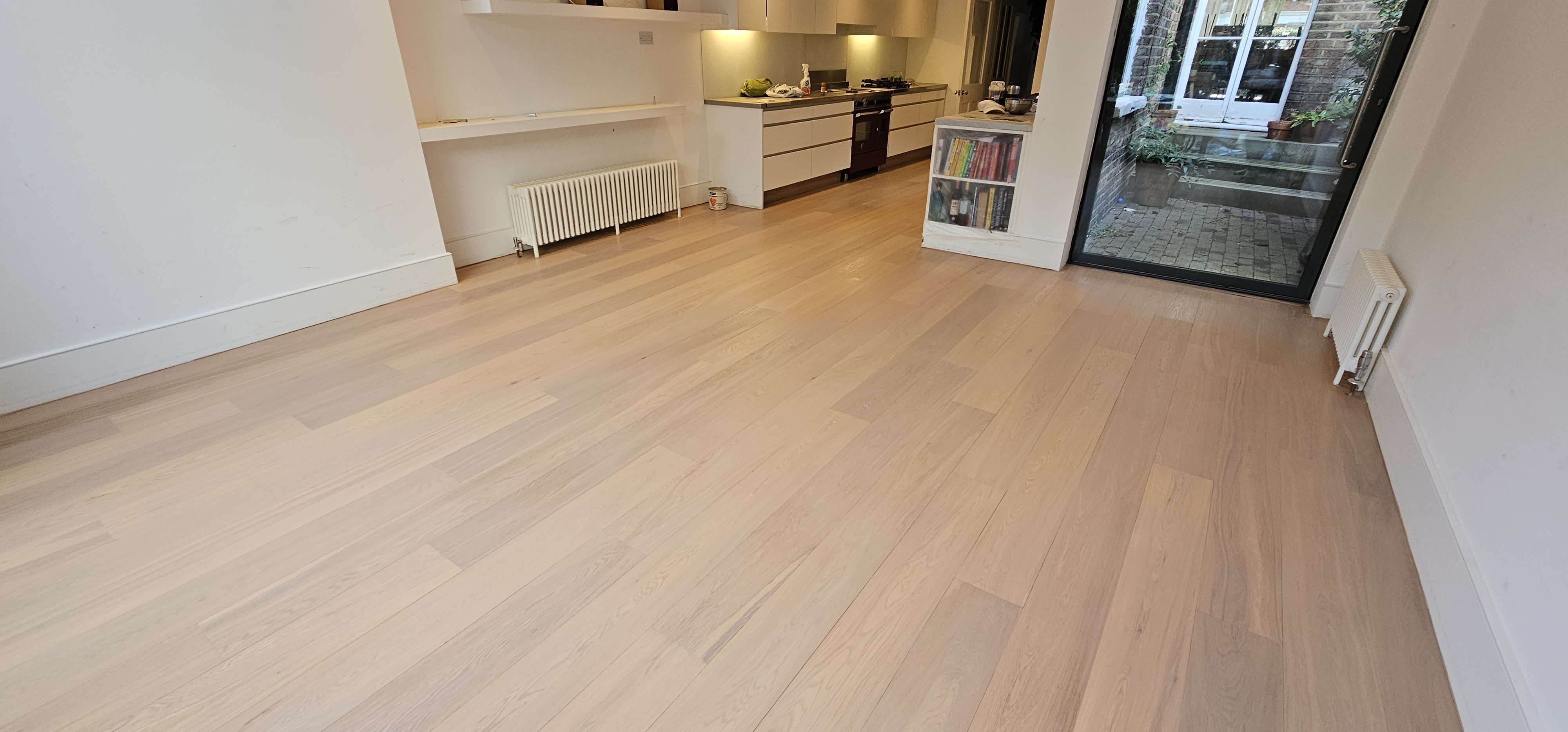


Engineered Floor Sanding in Upper Holloway
A Victorian terraced property in Upper Holloway came to us with original hardwood floors hidden beneath decades of varnish and surface wear. The owners wanted to restore the character of their ground and first floors without replacing the timber. We completed a full engineered floor sanding and finishing project across 85 square metres, returning the wood grain to its natural state.
Work carried out
- Multi-stage floor sanding using 40, 80, and 120 grit papers
- Dust containment and HEPA filtration throughout
- Edge sanding and corner work by hand
- Filler application to gaps and damaged sections
- Stain application in medium oak tone
- Three-coat polyurethane finish with sanding between coats
- Final buffing and inspection
About the project
The floors in this property had been sealed with a dark shellac finish that was both flaking and yellowing in patches. Previous attempts to refresh them with surface treatments had failed, leaving the owners with little choice but proper sanding. We assessed the timber depth (solid hardwood throughout) and found no significant cupping or structural movement, which meant sanding could proceed without complications. The main challenge was managing dust in a lived-in Victorian home where the owners wanted to remain on site during the work. We brought in temporary partition walls and negative air pressure equipment to contain the sanding dust to the work areas only.
The job took five working days from start to finish. Day one involved thorough preparation: removing skirting boards, laying dust sheets, and setting up containment. Days two and three covered the main sanding stages, working systematically across each room with graduated grit papers. Days four and five were finishing work: stain application, polyurethane coats, and careful final sanding between each layer. The owners chose a natural medium oak stain that complemented the existing period features without obscuring the wood's own character.
About our Upper Holloway service
Upper Holloway sits within a zone of solid Victorian and Edwardian terraced properties, most of which contain original floorboards beneath modern carpet or worn coverings. We regularly work across this area restoring period floors that have survived in the structure even when they've been covered for thirty or forty years. The typical floor in these properties is 3 to 4 inch solid timber, often a mix of pine and hardwood. These floors respond extremely well to sanding provided they haven't suffered water damage or significant rot, which is rare in the drier upper storeys of these homes.
The properties in Upper Holloway vary from Victorian stock through to some newer build developments, though the period terraces dominate. Modern properties in the area often come with engineered boards rather than solid timber, which require different sanding techniques and specialist equipment. Whether we're working on original floorboards or engineered boards, we adapt our approach to the specific timber thickness and stability. The older properties sometimes have floors that have moved or warped slightly over time, which we account for during sanding to avoid exposing gaps that weren't previously visible.
Frequently asked questions
How much does floor sanding cost per square metre?
Floor sanding in Upper Holloway typically costs between £25 and £45 per square metre depending on the floor's current condition, the amount of preparation needed, and the finish specification. Floors in good structural condition with minor surface damage are at the lower end of that range. Floors with deep staining, multiple previous finishes, or damage requiring filler work will be towards the higher end. We provide a detailed quote after visiting the property and assessing the timber.
How long does sanding take?
A typical residential project of 80 to 100 square metres takes five to seven working days from start to finish, including all dust management and finishing coats. Smaller projects of 30 to 40 square metres can usually be completed in three days. The actual sanding operation is only part of the time involved; preparation, stain application, multiple polyurethane coats, and sanding between coats make up the majority of the schedule.
Is the dust-free process genuinely dust-free?
Our dust containment system uses negative air pressure and HEPA filtration to capture 99.97% of fine particles at source. This means dust doesn't settle throughout the rest of your home. Some fine dust is inevitable with any sanding operation, but our containment approach keeps it confined to the work area only. We seal off doorways and maintain pressure differences so air flows toward the filtration, not out into other rooms.
Project Gallery